The Ship, the Village, and the Peacock
5th February 2024 ALJ216
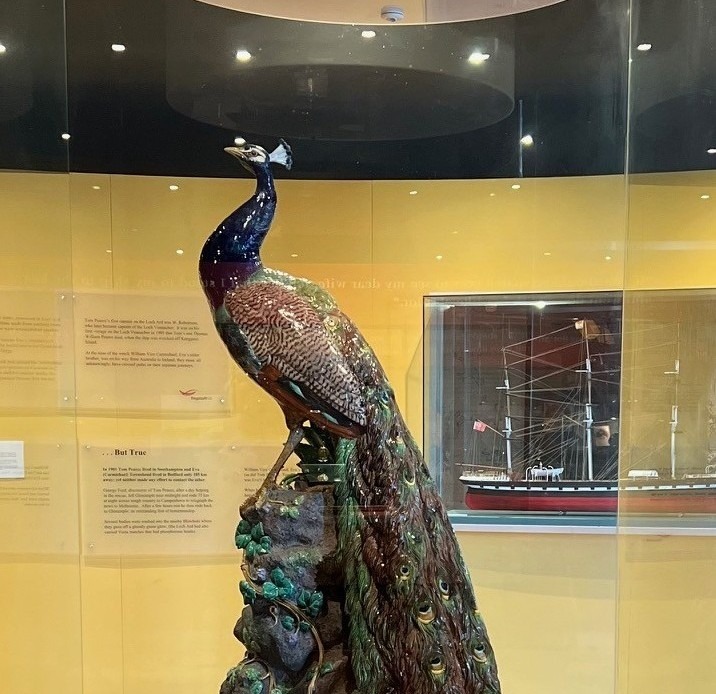
In the centre of the great circle gallery at Warrnambool’s Flagstaff Hill museum, stands a larger-than-life peacock statue with an equally impressive story. The circle gallery represents a compass, one of the most important tools in the early maritime era. The peacock stands about a metre and a half tall and is enclosed in a huge glass case. It is truly a beautiful piece of work, with its breathtaking realism and glistening finish, but why so much protection for a statue?
Flagstaff Hill was opened to the public in 1975, after three years of planning. It is one of the largest open-air heritage villages in Australia and home to Australia’s richest maritime collection. In the centre of the museum stands the pride of the collection, the Loch Ard Peacock. Estimated to be worth over $4 million, the peacock is a spectacular piece of work from England pottery company Minton and Co. However, it is not the value or the beauty of the peacock that is its redeeming feature, it is the story of its survival.
The Loch Ard, an iron-hulled 1,369-tonn ship, left England on March 2nd, 1878, carrying a general cargo bound for Port Phillip Bay. The occupants were a mix of crew members and affluent passengers looking to settle in Melbourne. Fast forward to June 1st, 1878, and they were no doubt keenly anticipating their arrival into Melbourne. After three months at sea, they were due at any moment to sight a hint of land in the form of the Cape Otway Lighthouse. A thick fog hindered the final stretch of the journey and once this lifted, it was discovered that the ship was much closer to land than thought, the sheer limestone cliffs of the Victorian west coast coming into view. An attempt to steer the ship away from the shallows was not successful and the Loch Ard struck a reef just out from Mutton Bird Island. Crew attempted to deploy lifeboats, but this failed due to rough conditions. The ship sank quickly. There were just two survivors of the wreck, Tom Pearce, and Eva Carmichael. Pearce sought refuge in a gorge and later went back into the sea to save Carmichael, who could not swim well. The gorge is now known as Loch Ard Gorge, a bittersweet tribute to the ill-fated ship and the 52 occupants who perished. The wreck of the ship still sits on the ocean floor, some 20 metres below.
Some of the contents of the ship washed up into the gorge and were salvaged. Among these items was a fortunately well-packaged Minton statue of a peacock, one of only nine in the world. Its destination was to be the 1880 Melbourne International Exhibition; however, it would never arrive. Miraculously the peacock had survived the wreck intact, with just a chip to the beak, and was found washed up two days after the Loch Ard sank. John Miller had purchased the salvage rights to the wreck of the Loch Ard and had the peacock lifted up the side of the cliff face to prevent it being claimed by the sea again.
The Loch Ard Peacock spent a number of years enjoying pride of place in the Miller family home in Geelong. In 1935 it was displayed at the Melbourne National Museum Exhibition, on loan to commemorate the 57th anniversary of the wreck of the Lock Ard. In 1943 it was sold at auction, purchased by Frank Ridley-Lee, and displayed in his Ivanhoe home. In 1975 the peacock was offered at auction again, but the reserve of $4,500 was not met. It was at this time that the Flagstaff Hill Maritime Village was in the process of being established. Great lengths were endured to purchase the rare statue and through fundraising via the Warrnambool City Council and contributions from the Fletcher Jones Company and the Victorian Government, the prize was secured. September 9th, 1975, saw Flagstaff Hill acquire the priceless statue for its collection. Since this time, the peacock has only left Warrnambool twice. In 1980 it was on display at the centenary celebrations of the Royal Exhibition Building in Melbourne (100 years after it was originally supposed to be displayed there), and in 1988 it featured in the entrance to the Victorian Pavilion at the Brisbane World Expo. The Loch Ard Peacock lays claim as the most significant shipwreck artifact in Australia. It was added to the Victorian Heritage Register in 2010.
Gerard Bourke is one of the volunteers at Flagstaff Hill and is known for his captivating heritage tours and is privileged with the firing of the cannons of the historic garrison. He is still as captivated by the Loch Ard Peacock as anyone laying eyes on it for the first time, but more so for the story that is hidden behind the huge glass case. “It was the glazing that was the particularly special feature of this one, it took glaze after glaze after glaze to try and get the features of the tail and the colours and so on all right, that’s what makes it magnificent. It’s quite a feature. It’s an extraordinary event that it was saved, really. It was just by absolutely sheer miracle that it was washed up after the wreck and was salvaged by the insurance company’s representatives.”
But the peacock held another secret, which was not uncovered until many years later, as Bourke explains. “Nobody knew it had been broken… but when it was sent to Brisbane it started to move in the heat, it started to melt the glue that was holding it together and the head started to move off. And of course, it had been insured for millions of dollars. And so, the people who had under contract taken it to Brisbane had it fixed, unbeknownst to Flagstaff Hill. It was only some years later when the invoice for the repairs was discovered. Nobody here knew, they just sent it back fixed.” It turned out that somewhere during its early travels, the peacock had been broken and repaired, but this remained unnoticed until the piece was exposed to the Queensland heat. When this break had occurred remains a mystery to this day.
The museum at Flagstaff Hill has over 10,000 objects. Visitors can learn about the treacherous journey early settlers had to make to travel to Victoria and view the impressive collection in the great circle gallery. Among these are such features as the Carmichael watch, recovered from the body of Eva Carmichael’s mother and later donated to the museum, and the Schomberg diamond, discovered hidden encrusted in a lid some 120 years after the sinking of the Schomberg. Each item has its own story as fascinating and heartbreaking as that of the peacock, which has pride of place in the centre of the great circle gallery.
Leaving the museum behind and walking out into the maritime village of Flagstaff Hill, one is transported to another world. Cobblestone pavers lead to a collection of buildings straight out of the 19th century. A doctor’s residence, a post office, a bank, a school, just to name a few. All outfitted in traditional period furniture and pieces, the village is home to over 40 buildings spread across ten acres. Each of these buildings is full of authentic furniture and items that were either uncovered from shipwrecks or donated to the village. Visitors can climb the lighthouse, which was moved stone by stone in 1871 from Middle Island to Flagstaff Hill, for breathtaking views of Lady Bay. This bay alone claimed around 27 ships, and many of the objects in the museum were found there. Staff members and volunteers in traditional period garments bring the village to life. “I think the future of the place is bound up heavily in the participation of people in here as volunteers or as employees, I think people in here bring the place to life,” Bourke says “The story of Warrnambool itself is told very well in the buildings and in the people who are here,” he continues, “The stories are the important part, I think, and we try and tell the stories.”
In addition to the charming nature of the village, is the obvious passion that the staff and volunteers have for the attraction. Visitors are greeted by individuals as immersed in the historical experience as their dress suggests. Glenda Peterson, who has been a volunteer at Flagstaff Hill for over nine years, has an obvious love for Flagstaff Hill and everything it stands for. “We think we’ve got an absolute diamond,” she says, speaking on behalf of the individuals who work hard to make the place such an experience. She takes pride in her delivery and is rewarded with comments about the authenticity and how well maintained the grounds and exhibits are, “I do the guided tours and I had Warrnambool people who hadn’t been through the village before, and they were very surprised by what was there and how well it was maintained.”
Peterson says that most of the people who come through the village are tourists, rather than local, “We get a lot from England, Sweden, Germany and Canada, all those European places,” she says. The school holiday programs are also popular, with crafts, needleworking, woodwork, cooking and other activities being offered, “We get good numbers through the school holidays.” School bus loads of children come from all around the state to visit the attraction.
“Warrnambool don’t know their history; it’s just a shame Warrnambool people don’t utilise it as much,” Peterson says. In the lead up to Christmas, the City Council offered free entry to Warrnambool residents to increase foot traffic through the village and museum. Over 600 people took advantage of the offer. One of these individuals, Jane Baker, has lived in Warrnambool for nine years yet had never been to Flagstaff Hill. “I really enjoyed it; it was a good day. I probably spent about two hours there, could’ve spent more,” she says, “My father was in the navy, so I’m very interested in maritime stuff, so I really enjoyed all that.”
Flagstaff Hill is operated by the Warrnambool City Council and while some weekends have seen record numbers of people attend the attraction, overall visitor numbers are steadily decreasing. This means an increase in the surplus that the council has had to pay to cover operating costs. This has totalled $7.2 million in the last decade. The sound and light show was implemented in the early 2000s, and later upgraded, however this did little to increase numbers. The council are now proposing a reimagining of the village and site. They have presented several possible solutions to the issue. The first is the least invasive, and involves enhancing the current experience, such as increasing activations of the exhibits and upgrading the sound and lights show, increased use for events and functions and adding dining and hospitality to the site. This option involves the least cost and risk, but also an estimated lower impact on tourism.
Another option, which is that preferred by the council, involves a total overhaul, and comes at a significant cost and risk. They propose a geothermal water park, a wellness centre, a hotel, hospitality precinct (brewery, distillery, café), and a function and events area. This option would also require private capital investment. To carry this out, some of the village, which the staff and volunteers have so painstakingly cared for over the past 50 or so years, will have to be removed. The proposition involves ‘repurposing’ those buildings that are suitable, while others will be decommissioned. Certain areas of the site, such as the lighthouse precinct, are heritage listed and so must be maintained, but the village itself would be at the very least condensed, if this option were to be carried out.
For the volunteers and staff of the village, it’s business as usual. They prefer to stay out of it and continue to lay tribute to those that come before them, those that lost their lives, and those that saved lives and allowed Warrnambool to become the city it is today. Only time will tell what will become of the village and its authenticity, whether it will become another victim of modernisation, but as long as it stands, the people of Flagstaff Hill will continue to entertain visitors with captivating and tragic stories of the past.
Post a comment